




Are Adhesive Document Pouches Waterproof?
September 29, 2026

 By
gobike1979
To evaluate the performance of an adhesive used for self-adhesive labels, one must look at three core metrics: initial tack, holding power, and peel strength.
Understanding these three indicators allows you to accurately avoid inferior products and select high-quality self-adhesive labels that are well-suited to your specific application.
Initial tack is also known as instantaneous tack which refers to an adhesive’s ability to instantly adhere to a surface upon brief contact and under slight pressure.
The standard industry testing method is the rolling ball test (GB/T 4852), which uses the size of the largest steel ball that can be successfully adhered as the basis for evaluation; the loop tack test and probe tack test are also employed in certain scenarios.
It bonds immediately upon light contact without slipping, edge lifting, or shifting, and can quickly conform even to slightly rough surfaces.
Adhesives of poor quality demonstrate weak initial tack; they tend to slide or fail to make full contact after application, requiring repeated pressing to secure them in place.
Holding power refers to the ability of an adhesive—once applied and set—to withstand sustained tension or gravity over the long term without shifting, detaching, or loosening.
The standard industry test is GB/T 4851. The procedure involves suspending a fixed weight from a bonded sample in a controlled, constant-temperature environment and either recording the time until detachment or measuring the displacement distance over a set period.
It supports loads over the long term without slipping, loosening, or showing significant displacement, and maintains consistent stability across both high and ambient temperatures.
Adhesives of poor quality exhibit weak holding power; they shift under short-term stress and are prone to detachment or component failure, especially in high-temperature environments.
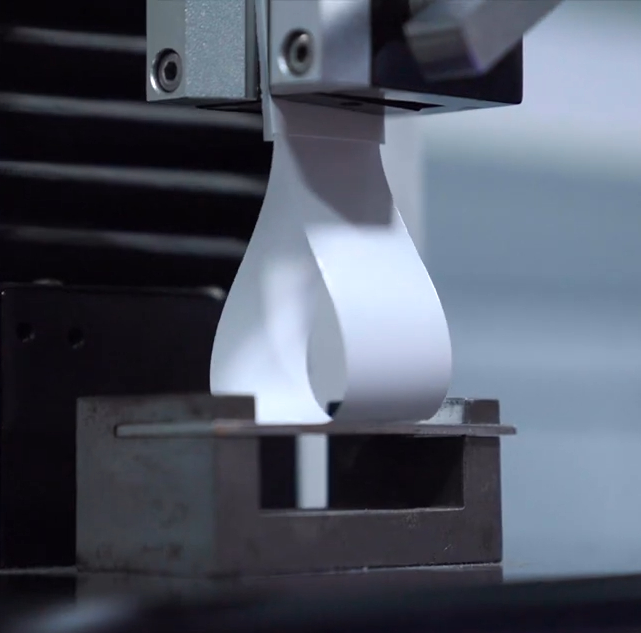
Peel strength is a key indicator of the ultimate bond integrity of an adhesive. It measures the tensile force required to peel the cured adhesive away from the substrate surface at a constant speed.
The standard industry test is GB/T 2792; the 180° peel test is commonly used, with results expressed in N/25mm.
The bond between the backing paper and the face material is tight, preventing easy or total detachment. During peeling, the adhesive layer remains intact, leaving no residue and showing no signs of adhesive failure or delamination.
Poor-quality adhesives detach easily during peeling, often exhibiting delamination, significant residue, and direct separation at the bonding interface.
September 29, 2026
September 29, 2026
September 29, 2026